
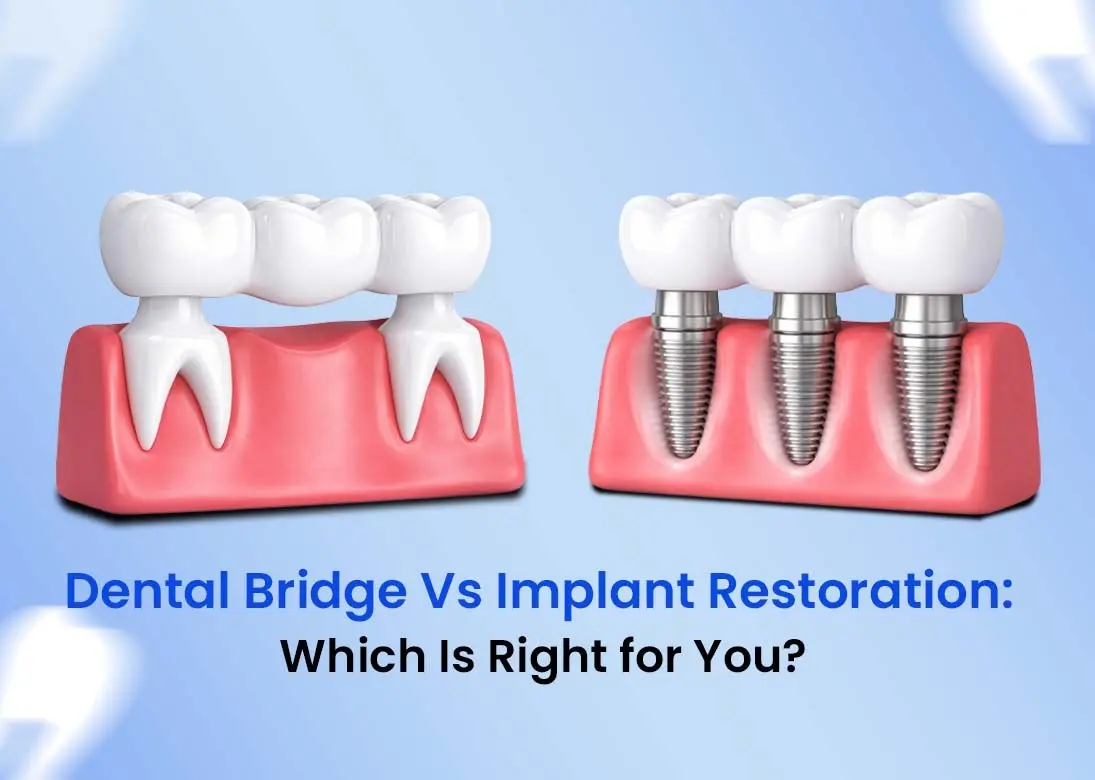
Dental Bridge vs. Implant Restoration: Which Is Right for You?
Selecting an appropriate alternative to a missing tooth or teeth is among the most important things to consider for your long term dental health. The two leading and most beneficial options are a dental bridge and an implant restoration. These two missing tooth options are entirely different from each other and provide various advantages in terms of life span, effect on adjacent teeth, and price.
Therefore, it is important to know this vital distinction and to choose your dentist wisely. When comparing dental bridge vs implant it is important to first develop a better understanding of their features. This guide will assist you in choosing the one that is more suitable for your individual requirements.
Comprehending the Alternatives: Dental Bridges vs Implants
Dental Bridge
A dental bridge is a fixed dental prosthesis that is utilized to replace one or more missing teeth. Being true to its name, it does “bridging” in the real sense. This consists of several artificial teeth together with dental crowns that are stuck on the natural teeth on the sides of the gap through abutment teeth. This technique has been a tooth replacement solution that is trustworthy for many years.
Dental Implant
On the other hand, a dental implant is a surgical tool that helps in the bone merging with the line and supports the device of a dental prosthesis. The implant is made of a titanium post that is placed into the jawbone, and it is considered an artificial tooth root. After the healing period, a tailor made crown is adjusted on the implant. This is the highest point of tooth replacement technology.
Comparison at a Glance
A quick reference guide is provided to show the main differences between a dental bridge vs implant in the easiest way possible:
| Dental Bridge | Dental Implant | |
| Durability | 5 to 15 years (Needs replacement) | Decades, potentially a lifetime |
| Adjacent Teeth | Requires grinding down | Leaves adjacent healthy teeth |
| Jawbone Health | Does not prevent bone loss | Prevents bone loss (stimulates bone |
| Procedure Time | Shorter (2-3 visits over weeks) | Longer (Requires surgery & healing over months) |
| Initial Cost | Lower | Higher |
Procedure and Longevity
Dental Bridge
A dental bridge is a less invasive procedure and can be performed in a shorter timeframe, usually in two to three visits.
- The neighboring teeth that will support the bridge must be reshaped and made smaller so that the crowns can fit.
- The conventional bridge, though proves to be effective, puts pressure on the surrounding teeth, which have to be in good condition to bear the force.
- A dental bridge has a lifetime of 5 to 15 years, but it may last even longer if kept with care.
- The adjacent teeth may get cavities or need to undergo root canal treatments, making it necessary to replace the bridge.
Dental Implant
A dental implant is a more complicated and time-consuming, requiring approximately a few months. Here’s what happens during the procedure of a dental implant:
- Firstly, the surgical step takes place where the titanium post is implanted.
- After the implant has fused with the jawbone through the osseointegration process, the placement of the abutment and the final crown follows.
- Despite the higher initial commitment, the long-term prospects are very positive.
- Dental implants that are properly cared for can last as long as one’s lifetime.
- Hence, making them a very sturdy alternative for single tooth restoration.
Oral Health Impact
Dental Bridge
A traditional bridge entails the cutting down of the adjacent healthy teeth to be the anchors for the crowns, because:
- This process leaves the anchor teeth more susceptible to both decay and sensitivity and can put more stress.
- This is an important point for a lot of patients who are considering the long-term health implications of a dental bridge vs implant.
Removing the bacteria under a bridge can prove to be more difficult, making it necessary to use special tools, for instance, floss threaders, to clean the area beneath the pontic.
Dental Implant
When talking about a dental implant, its undeniable effect on oral health can not be overlooked. Here’s what you need to know:
- Once a tooth is lost, the underlying jawbone starts to slowly shrink because there is no stimulation from chewing.
- Over time, the loss of bone may lead to the alteration of the facial contour and the unhealthy state of the neighboring teeth due to the pressure.
However, a dental implant remains the sole option for tooth replacement that maintains the jawbone’s activity and, hence, averts this bone loss.
Aesthetics and Function
Both bridges and implants lead to excellent aesthetic effects and showcase the same effective functionalities. They are designed to match the patient’s natural teeth.
Dental Bridge
A bridge can be just as good, but some people claim that they can feel the difference in the biting force compared to an implant. The aesthetic attraction of a bridge can be hampered by the occasional gum recession in the area of the abutment teeth or beneath the pontic.
Dental Implant
An implant gives a more realistic appearance and sensation most of the time. An implant that goes up through the gum tissue like a tooth offers the highest aesthetic quality, particularly when the tooth is in the anterior area. From a functional point of view, an implant grants the same degree of stability and strength while chewing that a natural tooth does.
Cost Considerations: Bridge vs Implant Cost
The discussion of bridge vs implant cost needs to encompass the long-term value aside from considering the initial price tag.
Initial Cost
The initial cost of a dental bridge is usually less than that of a dental implant procedure. This is a very attractive aspect for most patients, particularly when insurance reimbursement for a bridge is more generous than that of an implant.
Long Term Value
Though the initial cost of an implant is greater, the possibility of it lasting a longer period makes it the most cost-effective solution over a lifetime. A bridge is going to need replacement at least once, possibly several times, hence recurring costs will occur. Moreover, unexpected expenses can come from the possible complications that may arise with the abutment teeth. When looking at the long term expense of dental bridge vs implant, it has been observed that an implant proves to be more cost effective.
In The End
When choosing between dental bridge vs implant one must keep certain things in mind. The overall health of the patient, the number of lost teeth, the conditions of the teeth next to them, the state of the patient’s jawbone, and their budget. A bridge might prove to be an easier fix, whereas, in general, an implant is still a better choice. However, a consultation with the dentist is necessary. They will perform X-rays and will try to figure out your specific requirements. The right investment is all you need for your oral health and your smile.
Why Choose Supreme Smiles?
At Supreme Smiles Dentistry , we have a dentist’s office with the latest technology, a family atmosphere, and a commitment to being gentle and attentive to our patients. We do all kinds of dental work including preventive care, cosmetic and restorative treatments. We prioritize the patient’s long-term health and only recommend treatments that are really needed. Our practice guarantees that you will have personalized care where your smile can grow in confidence.